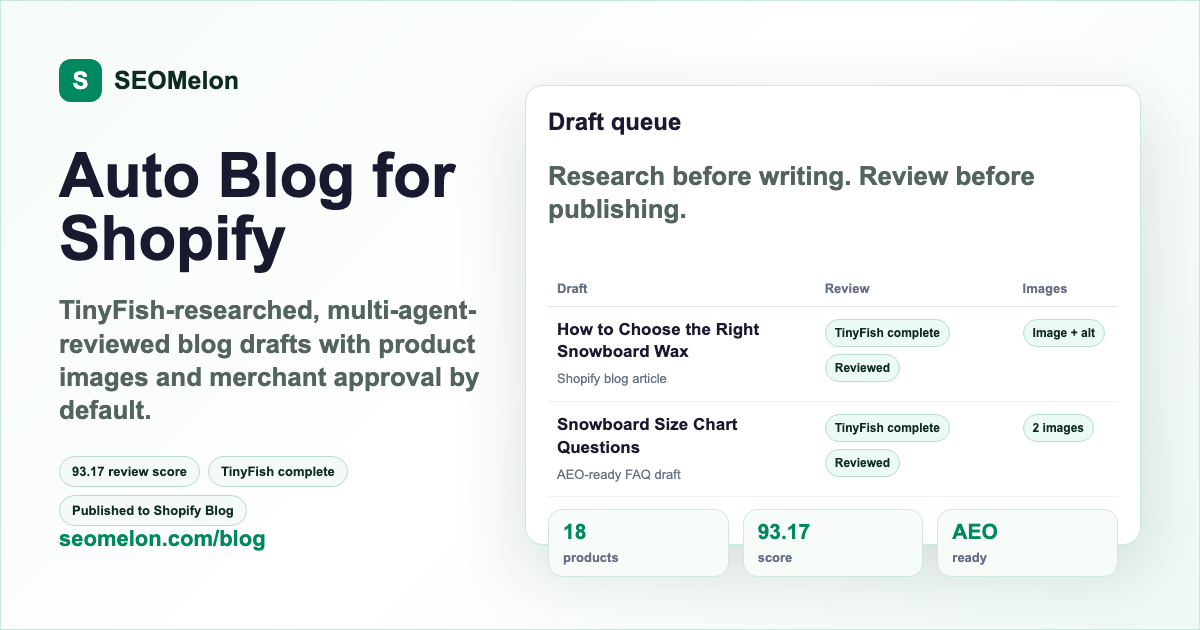
SEOMelon now has a working Auto Blog workflow for Shopify stores. The first target is Shopify's native blog, so merchants can keep posts inside the same content system they already use instead of wiring up another CMS.
The feature is designed around merchant-approved drafts by default. SEOMelon can generate the article, attach an image, check SEO and AEO quality signals, and prepare it for publication, but the merchant stays in control unless they explicitly turn on auto-publishing.
What the Auto Blog feature does
Auto Blog turns existing SEOMelon product intelligence into review-ready articles. Instead of asking a merchant to start from a blank page, SEOMelon looks at scanned product data, SEO/AEO gaps, available images, and buyer questions, then prepares a post that can be edited, approved, and published to Shopify.
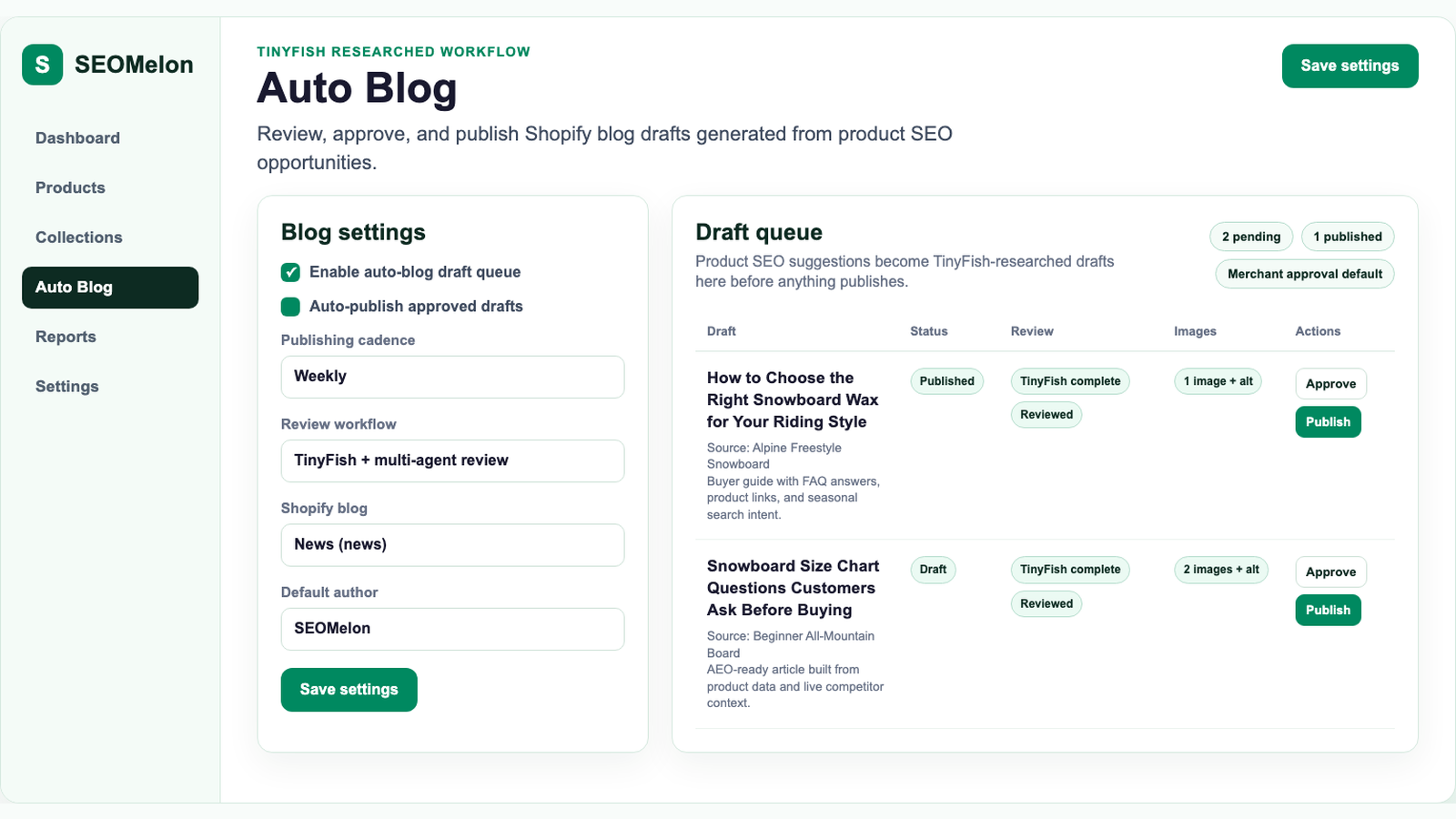
- Uses Shopify's built-in blog: posts publish to a selected Shopify blog such as News.
- Requires merchant review by default: drafts wait for approval unless the merchant chooses auto-publishing.
- Runs TinyFish research: the draft stores research context and source signals before review.
- Applies a multi-agent quality pass: topic fit, research, SEO, AEO, conversion, trust, and image checks are scored before publishing.
- Includes product images: SEOMelon uses Shopify product imagery where available and preserves alt text for accessibility and search context.
- Adds SEO and AEO metadata: each article can carry meta title, meta description, answer-summary fields, FAQ structure, and internal product links.
Why this matters for Shopify merchants
Most Shopify stores have product pages, collections, and a blog, but the blog is often underused because writing useful posts takes time. At the same time, AI search and answer engines need clearer context around products, use cases, buyer questions, and store expertise.
Auto Blog is meant to close that gap. It gives merchants a steady pipeline of practical buying guides, product explainers, FAQ-led posts, and seasonal recommendations that connect back to real product pages. The goal is not to publish generic articles. The goal is to create useful, store-specific content that helps shoppers and gives search systems more structured context.
The proof run
We tested Auto Blog on a Shopify development store with 18 scanned products. SEOMelon generated a draft for a snowboard product, researched the topic with TinyFish, ran the draft through the review pipeline, selected a Shopify product image, and published the approved article to the store's native News blog.
The generated article passed with a 93.17 review score. The Shopify readback confirmed the article was published, had a Shopify-hosted featured image, included alt text, and stored SEOMelon SEO/AEO metafields.
Default behavior is still review-gated. Auto-publish exists as an option, but it should be reserved for merchants who want a higher-trust automated content flow and have a strong enough review score threshold.
SEO and AEO are part of the draft, not an afterthought
Each draft is built to answer shopper questions directly, include internal links to relevant products, and support traditional search metadata. The same article can help with classic SEO while also giving answer engines a cleaner summary of what the store sells, who the product is for, and what a shopper should compare before buying.
That means the article is checked for practical signals before it reaches Shopify: concise meta fields, a short answer block, FAQ-ready content, source-backed research, trust and safety review, and image readiness.
What comes next
The first shipping target is Shopify Blog because it is already built into every Shopify store and gives merchants a familiar place to review posts. Newsletter reuse is a logical stretch goal: once a merchant approves a blog post, SEOMelon can eventually adapt the same content into an email draft, campaign snippet, or social post.
For now, the important milestone is that the end-to-end Shopify blog loop is working: product scan to researched draft, reviewed article, image, approval, and native Shopify publishing.