
Search has changed more in the past two years than in the previous decade. If you’re still measuring success purely by traditional rank positions, you’re optimizing for a system that no longer fully controls your visibility. Understanding what is AI search ranking is now a baseline requirement for any SEO professional who wants to stay relevant. AI search ranking is not a replacement for traditional SEO. It’s a new layer built on top of it, and knowing how that layer works changes everything about how you create, structure, and measure content.
Table of Contents
- Key takeaways
- What is AI search ranking, exactly
- Traditional SEO vs. AI ranking factors
- Adapting your SEO strategy for AI search
- Advanced AI ranking concepts you need to know
- What to watch in AI search ranking
- My take on what most SEO pros get wrong
- Optimize your AI search presence with Seomelon
- FAQ
Key takeaways
| Point | Details |
|---|---|
| AI builds on traditional ranking | AI search ranking uses classic retrieval as its foundation before applying AI synthesis. |
| Binary inclusion replaces positions | Your content is either cited in an AI answer or it isn’t. There is no position 2. |
| New factors now drive citations | Topical authority and answer extractability outweigh domain authority in AI ranking. |
| Technical SEO still matters | Bot-blocking and nosnippet tags can disqualify content from AI citation entirely. |
| Measurement must evolve | Track AI citations and synthesized answer presence, not just traditional rank positions. |
What is AI search ranking, exactly
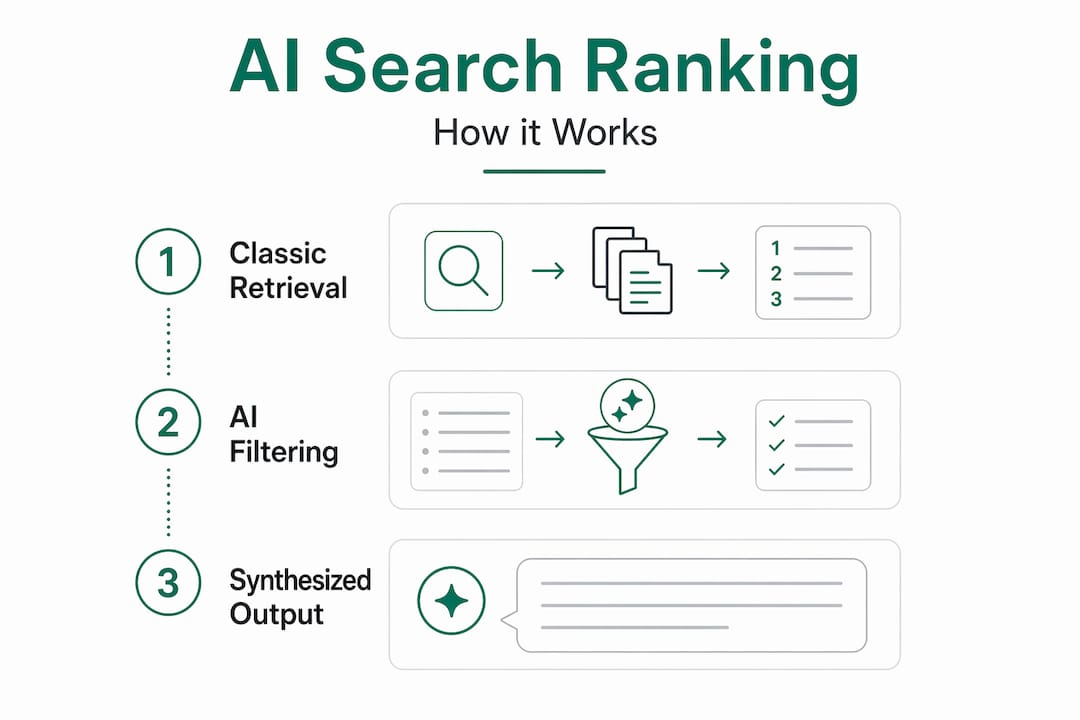
Most people assume AI search ranking means Google replaced its algorithm with a chatbot. That’s not what happened. Google’s staged pipeline still starts with classic retrieval, pulling tens of thousands of candidate documents using traditional ranking signals. From that pool, a smaller subset gets reranked. Then a Large Language Model synthesizes an answer from those top candidates.
This means traditional SEO is not dead. It’s the gatekeeper. If your content doesn’t make it through the initial retrieval stage, no AI model will ever see it. The AI synthesis layer only operates on what classic ranking already approved.
Here’s what happens at each stage:
- Retrieval: Classic ranking signals (backlinks, relevance, page speed) filter the full web down to tens of thousands of candidates.
- Reranking: A secondary AI model scores that smaller set based on answer quality, factual precision, and content structure.
- Synthesis: The LLM generates a response, pulling quotes and facts from the highest-scoring documents and citing them as sources.
The practical takeaway is that AI search does not bypass traditional ranking. It sits on top of it. You need both layers working in your favor.
Pro Tip: If your pages aren’t indexed or ranking for at least some traditional signals, they will never appear in AI-generated answers. Fix crawlability and indexation before worrying about AI optimization.
Traditional SEO vs. AI ranking factors
Classic SEO and AI search ranking share a foundation, but they diverge sharply on what moves the needle beyond initial retrieval. Here’s a direct comparison:
| Factor | Traditional SEO | AI Search Ranking |
|---|---|---|
| Backlinks | High importance | Moderate, still needed for retrieval |
| Keyword match | High importance | Lower, semantic understanding dominates |
| Page speed | Important | Still required, not a differentiator |
| Content structure | Helpful | Critical for answer extractability |
| Topical authority | Moderate | Very high importance |
| Entity credibility | Low focus | Core signal for citation selection |
| E-E-A-T signals | Growing | Dominant in AI citation decisions |
| Factual precision | Assumed | Actively verified by AI models |
The data here is striking. 47% of AI Overview citations come from pages ranking below position five in traditional search. That tells you domain authority alone no longer guarantees AI visibility. A focused, authoritative page on a narrow topic can beat a high-authority domain if it answers the query more precisely.

This shift is what the industry calls Answer Engine Optimization, or AEO. Where traditional SEO focuses on getting ranked, AEO focuses on content extractability and being cited inside a synthesized answer. The goal changes from “rank on page one” to “become the source the AI quotes.”
E-E-A-T signals are now the backbone of AI citation decisions. Experience, expertise, authoritativeness, and trustworthiness are not abstract quality signals anymore. AI models actively look for verifiable author credentials, cited sources, and fact-checked claims when deciding what to include in a generated answer.
Pro Tip: Add clear author bylines with credentials, cite your sources inline, and use structured data to mark up your content. These signals directly improve your AI citation eligibility.
Adapting your SEO strategy for AI search
Understanding AI ranking factors is one thing. Changing how you work is another. Here’s how to adapt your strategy in practical terms:
-
Structure content for extraction. Write in clear, self-contained units. Each section should answer one specific question completely. AI models pull discrete chunks, not full articles. If your answer is buried in three paragraphs of context, it won’t get cited.
-
Shift your KPIs. Google AI Mode powered by Gemini now handles 65% of informational queries. Traditional rank correlation with AI citations has weakened significantly. Start tracking AI citations, presence in synthesized answers, and brand mentions inside AI Overviews alongside traditional rank data.
-
Prepare for traffic pattern changes. AI Overviews appear in over 50% of searches and correlate with a 61% drop in CTR for traditional organic results. Informational content is especially exposed, with organic traffic declining 20% to 40% year-over-year for query types that AI now resolves directly on the SERP.
-
Audit your technical SEO for AI accessibility. Check that Googlebot and AI crawlers are not blocked by your robots.txt. Review your meta tags for nosnippet directives that could disqualify content from AI citation. Confirm that your structured data is valid and complete.
-
Build topical depth, not just breadth. A site that covers one topic thoroughly from multiple angles is more likely to be cited than a site with thin coverage across many topics. Cluster your content around core entities and questions your audience actually asks.
Pro Tip: Use FAQ schema and how-to schema markup on pages targeting informational queries. Structured data gives AI models a clear map of your content’s structure and intent, increasing citation probability.
Advanced AI ranking concepts you need to know
Once you understand the basics, a few deeper mechanisms separate good AI optimization from great AI optimization.
The first is the fan-out mechanism. When a user submits a query, AI search engines don’t just run one search. They perform related secondary queries to gather supporting evidence and ground the primary answer. If your content ranks for those secondary queries, your citation probability increases even if you don’t rank for the primary term. This means writing content that covers related subtopics and questions within a piece is a direct AI ranking tactic, not just good UX.
The second concept is binary inclusion. AI search ranking is binary, not hierarchical. In traditional search, you might rank position 3 and still get meaningful traffic. In AI search, your content is either included in the generated answer or it isn’t. There is no position 2 in an AI Overview. This fundamentally changes optimization goals. You’re not chasing a higher rank. You’re qualifying for inclusion.
The third area is technical disqualification. Aggressive bot-blocking or nosnippet directives can remove your content from AI citation consideration entirely, regardless of how good the content is. AI models need to crawl and read your content to include it. A technically sound page with average content can outperform a brilliant page that blocks crawlers.
- Audit your robots.txt file specifically for AI crawler agents.
- Remove nosnippet meta tags from pages you want cited.
- Confirm your site loads correctly for bots, not just browsers.
- Use server-side rendering if your content relies heavily on JavaScript.
Pro Tip: Test your pages using Google’s Rich Results Test and URL Inspection Tool to confirm AI crawlers can access and parse your content correctly before investing in content optimization.
What to watch in AI search ranking
The AI search space is moving fast. A few trends are worth tracking closely.
The citation and synthesis algorithms inside AI models are not static. As models improve, the signals they weight will shift. Content that earns citations today may need to be updated as AI models get better at verifying facts and detecting thin coverage. Treat AI citation as an ongoing maintenance task, not a one-time optimization.
Entity recognition is growing in importance. AI models increasingly organize knowledge around entities (people, brands, products, places) rather than just keywords. Building a clear, consistent entity presence across your site, your author profiles, and external references like Wikipedia and knowledge panels will become a stronger ranking signal over time.
Multi-modal and voice search integration is expanding. AI search is no longer text-only. Images, video transcripts, and spoken queries are all feeding into AI-generated answers. Optimizing alt text, video descriptions, and structured data for non-text content is no longer optional for brands that want full AI visibility.
- Monitor your brand’s entity recognition across AI tools and knowledge panels.
- Optimize all content types (images, video, audio) with structured metadata.
- Watch for algorithm updates that shift citation weighting toward newer E-E-A-T signals.
- Track competitor citations in AI Overviews to identify content gaps.
My take on what most SEO pros get wrong
I’ve watched a lot of smart marketers spend 2025 and 2026 doubling down on traditional ranking tactics while their AI visibility quietly dropped to zero. The mistake isn’t ignoring AI search. It’s treating it as a separate discipline instead of an integrated layer.
What I’ve found is that the biggest leverage point isn’t content volume. It’s content structure. A single, well-structured page that answers a question with precision, cites its sources, and uses clear headings will outperform ten loosely written articles every time in AI citation selection. Most teams are still writing for humans who scroll. AI models read differently. They extract. They verify. They synthesize.
The measurement gap is also underestimated. If you’re still reporting only on rank positions and organic sessions, you’re missing half the picture. AI citations don’t always drive clicks. But they build brand authority in a way that compounds over time. I’ve seen brands get cited in AI Overviews consistently for months before their traditional metrics showed any change. The signal came first. The traffic followed.
My honest advice: stop treating AEO as a future problem. It’s a present one. Audit your most important pages for answer extractability this week. You don’t need to rebuild your entire content strategy. You need to restructure what you already have.
— Matthew
Optimize your AI search presence with Seomelon
If you’re running a Shopify store, the shift to AI search ranking affects your product pages, collection pages, and blog content directly. Getting cited in AI Overviews requires the right structure, schema markup, and content signals, and doing that manually across hundreds of pages is slow.
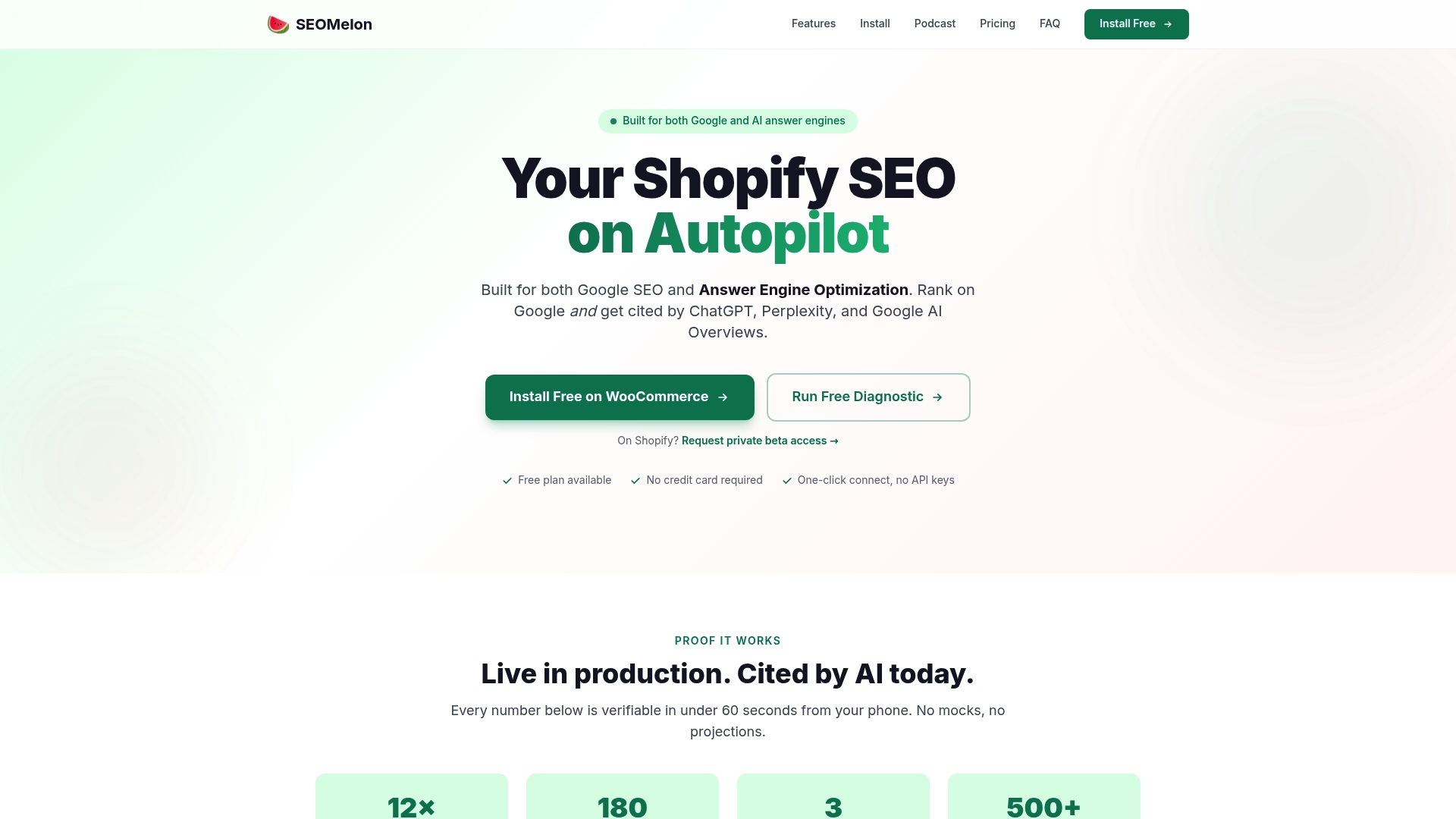
Seomelon is built specifically for this. It scans your Shopify store, generates optimized SEO and AEO content, and applies schema markup automatically. You get AI citation-ready pages without rebuilding your store from scratch. Whether you’re starting fresh or optimizing an existing catalog, Seomelon connects your content to the signals AI search engines actually use to select citations. Install it from the Shopify App Store and start seeing your AI visibility grow.
FAQ
What is AI search ranking in simple terms?
AI search ranking is the process by which AI-powered search engines retrieve, rerank, and synthesize content from the web to generate direct answers. Your content either gets included in those answers or it doesn’t.
How does AI search ranking differ from traditional SEO?
Traditional SEO focuses on ranking positions in a list of results. AI search ranking focuses on whether your content is cited inside a generated answer, with topical authority and content structure playing a larger role than domain authority alone.
Does traditional SEO still matter for AI search?
Yes. Classic ranking signals are the first filter AI search uses. If your content doesn’t pass traditional retrieval, it never reaches the AI synthesis stage.
What is Answer Engine Optimization (AEO)?
AEO is the practice of structuring content specifically to be extracted and cited by AI-generated answers. It extends traditional SEO by prioritizing factual precision, clear structure, and entity credibility over keyword density.
Can technical issues block AI from citing my content?
Yes. Bot-blocking settings and nosnippet tags can prevent AI crawlers from accessing your content entirely, disqualifying it from citation regardless of content quality.